
What The Mirror Method® Actually Is
- May 18
- 5 min read
Updated: May 19

Most design starts with the designer. A signature style. A recognizable aesthetic. A look that the client adapts to.
The Mirror Method® starts with you.
It's a way of working that treats every project as a question, not an answer. The question is some version of this: What is already true about this person, brand, culture, or product, and how do we design an environment that reflects it back?
That sounds simple. It's not. Most people can't articulate their own taste, their own culture, or their own brand without help. They know what they don't like. They know what catches their eye on Pinterest. But the deeper layer, the one that makes a space feel like theirs instead of someone else's version of nice, usually isn't as readily accessible.
Our job is to find it. The design is what happens after.
This is why we don't have a signature aesthetic. By design. If you walked through ten BSD projects, you wouldn't recognize them as ours by how they look. You'd recognize them by how they feel, like they belong to the person, brand, or company they were made for.
Four Channels, Four Lenses, One Method
We work across four channels: residential, commercial, showroom and manufacturer, and multifamily. People who know us through one channel often don't realize we work in the others. That's partly our fault. We haven't always told the whole story.
Here's the whole story. Each channel is a different lens on the same method.

Residential: The Most Personal Mirror
This is where the method began. A home is the most intimate environment a person inhabits, and designing one well means understanding things people don't usually say out loud. How they actually live, not how they think they should live. What they keep, what they hide, what they wish they'd let go of years ago.
We start with conversations that feel less like design intake and more like genuine curiosity. We look at what's already in the closet. We ask about the houses you grew up in, the spaces that have made you feel most yourself, the things you've held onto across moves. The design that follows isn't an aesthetic we picked for you. It's a reflection of what we heard.
When clients walk through their finished home for the first time, the response we're listening for isn't "this is beautiful." It's "this feels like us."

Commercial: The Most Public Mirror
A commercial space is a brand standing still. Every choice – the entry, the lighting, the textures, the rhythm of the space – tells visitors something about who the company is and what they value. Most commercial design treats this as decoration. We treat it as a translation.
Before we sketch anything, we want to know what the company actually believes. Not the mission statement. The real thing. The culture employees describe when no one's writing it down, the values that show up in how decisions get made. A workplace that reflects that is a workplace people want to be in. A retail or hospitality space that reflects what customers remember.
Commercial brands sometimes hand us a brand book and expect us to design from the guidelines. We read the guidelines. Then we ask about the stories and the people behind them. The guidelines tell us what the brand looks like. The stories tell us what it is.



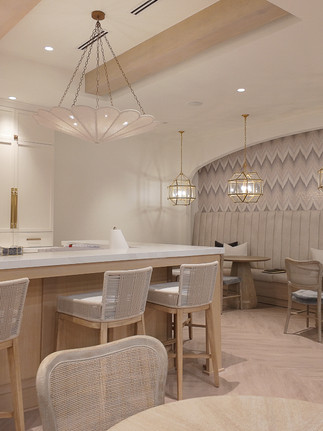
Showroom: The Mirror at the Source
This is the work fewer people know about, and it's some of the most meaningful we do. We design showrooms and brand experiences for manufacturers. The spaces where products meet the people who specify, sell, and buy them.
The instinct here is the same. Before we design the showroom, we want to understand the product at the source. What were the makers trying to do? What problem were they solving? What do they care about that the marketing doesn't capture? A product carries the values of the people who made it, and a showroom that reflects those values does something a generic display never will. It lets the product speak in its own voice.
Working in this channel sharpens everything we do in the others. When you spend time understanding how products are made and what they're really for, you design residential and commercial spaces differently. You specify differently. You see things other designers don't.

Multifamily: The Mirror at Scale
Multifamily design has a built-in tension. It has to serve many people while still feeling personal to each one. Most multifamily design solves this by leaning generic, neutral enough that no one objects, distinctive enough to photograph well. We think there's a better answer.
The Mirror Method® at this scale means designing for the community the property is trying to build, not just the units it's trying to fill. Who lives here? What kind of life are they coming home to? What does this neighborhood, this city, this region bring to the experience that a generic palette would erase? When multifamily design reflects something true about its place and its people, residents feel it, even if they couldn't tell you why.
This is also where the insights we’ve gained from residential projects matter most. We design these spaces knowing how people actually live in them, not just how they look on a leasing tour.
Why Four Channels Make One Studio Stronger
We get asked, occasionally, why we don't specialize. Why not pick one channel and go deep?
The answer is that we have gone deep, in all four. And the cross-pollination between them is the thing that makes our perspective hard to replicate.
A residential designer who's never worked commercial doesn't know how a space holds up under daily public use. A commercial designer who's never worked residential doesn't know how to make a workplace feel like somewhere a person actually wants to spend their day. A designer who's never sat with a manufacturer doesn't fully understand the products they're specifying. A designer who's never worked multifamily underestimates how hard it is to make scale feel intimate.
We've done all of it. Every channel teaches the others. That combined experience is the quiet engine underneath The Mirror Method®. It's why the questions we ask in a discovery meeting are better, and why the spaces we design hold up.
What This Means If You're Considering Working With Us
The Mirror Method® is slower at the front end than most design processes. We ask more questions. We listen longer. We don't show up with a look we're going to apply to your space.
What you get on the other side is a space that doesn't go out of style, because it was never in a style to begin with. It was a reflection of you. And the things that are true about you tend to stay true.
If that's the kind of work you've been looking for, we should talk.
